Type-C Motherboard Coil & Inductor Diagnostic Tester – Circuit Board Detection Tool 🔍
Type-C Motherboard Coil & Inductor Diagnostic Tester – Circuit Board Detection Tool 🔍
BUNDLE & SAVE
Couldn't load pickup availability
-
Ordered
- - -
Order Ready
- - -
Delivered

Type-C Motherboard Coil & Inductor Diagnostic Tester – Circuit Board Detection Tool 🔍
Screen Motherboard Coils Without Turning Every Check Into A Full Teardown.
A compact Type-C-powered inductance screening tool designed for motherboard coils, inductors and small electromagnetic components. Bring the sensing tip near the target component, press the test button and use the green LED response as a quick diagnostic reference.
The current seller listing describes electromagnetic induction detection without needing the sensing tip to electrically probe the component terminals.
Seller guidance uses the green indicator as a fast normal / abnormal screening reference during testing.
The listing positions the tester for phone motherboards, circuit boards, coils and inductor-related troubleshooting.

Use Inductive Response To Narrow Down Which Coil Deserves A Closer Look.
The current listing describes the tool as an electromagnetic-induction detector for quickly checking inductors, coils and related components. It is intended as a first-pass diagnostic aid that can help a technician identify suspicious areas before moving to more detailed electrical testing.
Position the narrow sensing terminal close to the component being screened.
A single physical button on the board activates the seller-described detection routine.
The green LED provides the visual response used by the seller's screening method.

Green Light On? The Seller Treats That As A Normal Inductive Response.
According to the current product instructions, an illuminated green LED is used as the expected response for a normally functioning inductor. If the indicator does not illuminate, the seller treats that result as a reason to investigate the component further.
Current seller guidance interprets this as a normal response from the tested inductor or coil.
The seller flags this as an abnormal screening result that may justify additional fault diagnosis.
Use conventional measurements and circuit knowledge before replacing or reworking a component.

Power Port, Test Button, LED And Sensing Tip—Everything Is Right On The Board.
Current product imagery labels the main controls directly on the tester. The exposed-board format keeps the workflow intentionally simple for bench-side component screening.
Connect a suitable Type-C power source according to the supplied product instructions.
The central tactile switch is the primary physical control shown on the board.
A green LED near the lower section provides the seller-described visual test result.

Plug Into Type-C Power And Keep The Tool Ready At The Bench.
The current listing identifies this as the Type-C power-supply version. It is designed to operate while connected to external power rather than relying on an internal rechargeable battery.
The top-mounted Type-C connector provides the tester's operating power.
Seller FAQ states that the tester remains connected to Type-C power during operation.
The current product page does not describe an internal battery or charging cycle.

A Narrow Sensing Tip Reaches Into Component-Dense Board Areas.
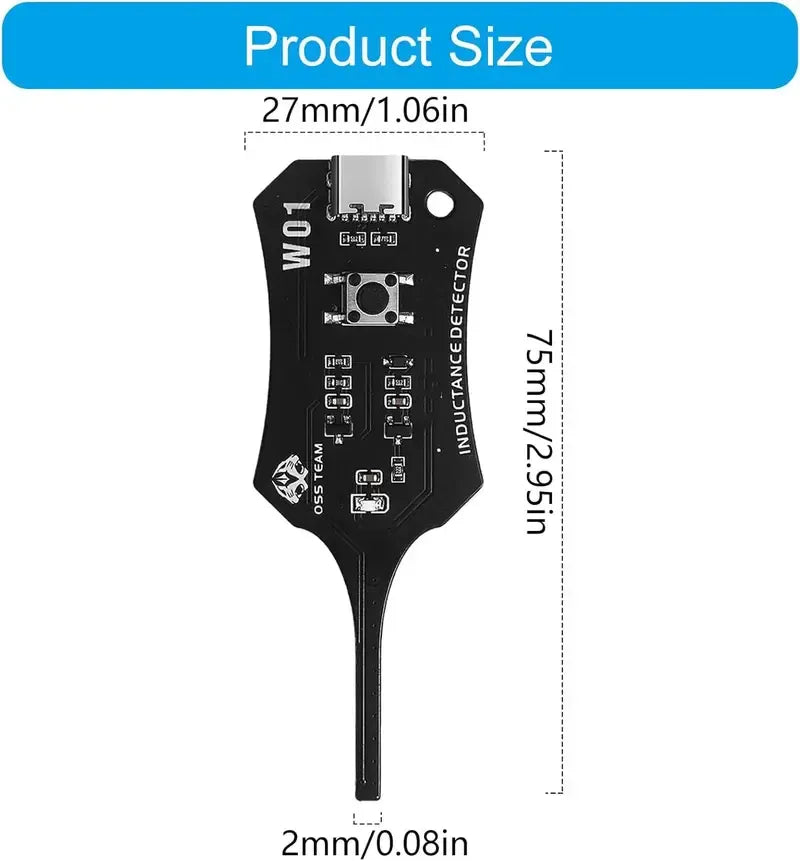
Current product imagery labels the tester at approximately 75 mm long, 27 mm wide and 2 mm thick. The lower section narrows into a slim sensing terminal intended for close positioning near small board components.
Current dimension imagery labels the overall length at about 75 mm / 2.95 in.
The widest upper body is labeled about 27 mm / 1.06 in.
Current seller imagery labels the board thickness at approximately 2 mm / 0.08 in.

Use It Where Coils And Inductors Are Packed Into Compact Circuit Boards.
The current listing specifically positions the tester around phone motherboard repair and other small circuit-board work involving inductors, coils and electromagnetic components.
The Seller's Workflow Comes Down To Three Basic Steps.
Power the tester from a compatible Type-C source according to the supplied instructions.
Position the narrow sensing end close to the inductor or coil you want to screen.
Press the detection button and use the green-light response as the seller-described screening reference.

No Display Menus. No Rotary Dial. No Complicated Setup Screen.
The current tool is an exposed compact circuit-board instrument with a Type-C port, tactile push button, indicator LED and elongated sensing terminal. Its job is focused on rapid inductive-response screening rather than displaying numerical inductance values.
The device provides indicator-light feedback rather than an inductance reading in µH or mH.
The current product design centers operation around a single tactile detection switch.
Best understood as a fast supplementary diagnostic aid before more detailed component-level measurements.

A Focused Diagnostic Aid For Rapid Coil And Inductor Screening.
Wired Type-C Power
The current listing identifies this model as the Type-C-powered version and states that it operates while connected to power.
Non-Contact Detection Principle
The seller describes electromagnetic induction as the operating principle for screening nearby coils and inductors.
Green Visual Feedback
A dedicated green indicator light provides the current seller's simple normal / investigate-further test cue.
Approx. 75 × 27 × 2 mm
Current product imagery labels the board at approximately 75 mm long, 27 mm wide and 2 mm thick.
Motherboard Coil Screening
Phone motherboards, circuit boards, coils, inductors and small electromagnetic components are the stated target applications.
Single-Button Workflow
Connect power, position the sensing terminal, press the switch and observe the indicator response.
What The Current Product Page Clearly Supports.
| Product Type | Motherboard coil / inductor diagnostic screening tester |
|---|---|
| Power Supply | Type-C wired external power according to the current listing |
| Detection Principle | Electromagnetic induction detection according to the seller |
| Detection Style | Non-contact proximity screening of compatible inductive components |
| Result Indicator | Green LED visual indicator |
| Main Control | Single tactile detection button |
| Sensing Area | Narrow elongated detection terminal at the bottom of the board |
| Seller-Listed Applications | Phone motherboards, circuit boards, coils, inductors and electromagnetic components |
| Approx. Dimensions Shown | 75 × 27 × 2 mm / 2.95 × 1.06 × 0.08 in in current product imagery |
| Package Contents | 1 × Type-C motherboard inductance / coil tester according to the current listing |
Protect The Board, The Tester And Your Diagnostic Process.
Do not assume an unknown board is safe to probe while energized. Follow the device service procedure and supplied tester instructions.
Sensitive phone and electronics boards can be damaged by static discharge, so normal anti-static handling practices are appropriate.
Verify suspected component faults with suitable electrical measurements before replacing or reworking parts.
Before The First Board Check.
What does this tester check?
How does it detect an inductor?
Does it display the inductance value?
What does the green light mean?
What does it mean if the green light does not turn on?
Is this a replacement for an LCR meter?
Does the sensing tip need to touch the component?
Does it need to stay connected to Type-C power?
Does it have a built-in rechargeable battery?
What Type-C charger should I use?
Can it test small motherboard coils?
Can it locate every motherboard fault?
What are the approximate dimensions?
What is included?
Is the tool suitable for beginners?
Add A Fast Inductive Check To Your Component-Level Troubleshooting Workflow.
Keep this compact Type-C-powered tester near the repair bench for quick non-contact screening of motherboard coils, inductors and related electromagnetic components before moving on to deeper electrical diagnosis.
Add Quick Coil Screening To Your Bench ↑Diagnostic screening tool only. Current Valorsca materials support Type-C wired power, electromagnetic-induction screening, a green LED indicator, single-button operation and use around phone motherboard coils, inductors and small electromagnetic components. The seller's green-light logic is a screening convention and should not be treated as a guaranteed component diagnosis. Exact inductance range, calibrated accuracy, sensitivity, input voltage/current, detection distance and weight are not clearly published and are therefore not claimed. Follow proper ESD, power-isolation and electronics-repair procedures, and confirm suspected faults with appropriate measurement equipment before rework.